The Two-Minute Routine: Decide What Earns a Place at the Sink
A short skincare routine works best when each product has a clear job, a sensible place in the sequence, and enough time to use it comfortably.
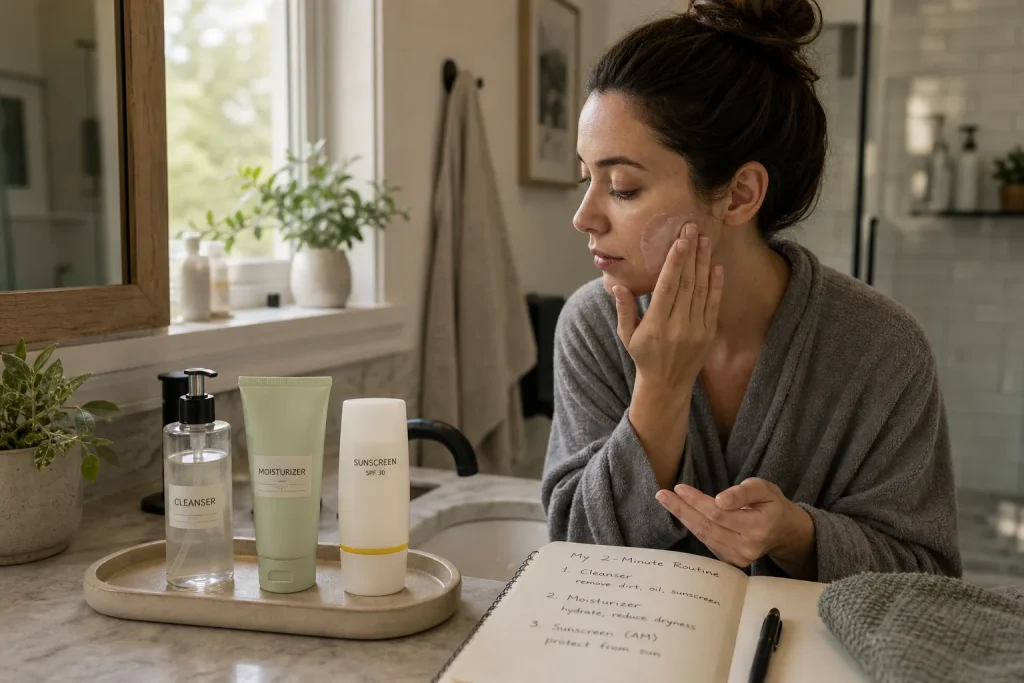
A two-minute skincare routine has room for only the products you can use without rushing. Start by deciding what your skin needs from the routine, then give each product a clear job and a place in sequence. The aim is not to fit every bottle at the sink. It is to make the products already in use easier to reach, apply, and repeat.
Think of the routine as a small countertop, not a miniature version of a longer one. A crowded countertop makes it harder to find the tool you need; a crowded routine can make you unsure what to apply next. A simple order turns the sink into a useful cue: cleanse if needed, apply the treatment or moisturizer you use, then finish with daytime protection when appropriate.
Start With The Moment
Separate morning and evening before choosing products. They happen under different conditions and may have different purposes. In the morning, you may be getting ready to go outside. In the evening, you may be removing sunscreen, makeup, or the day’s residue before applying a moisturizer or a product you use at night.
Write down what you actually do now, without adding an ideal routine from memory. Include the products you use consistently and any you reach for only sometimes. Note which ones are for cleansing, moisturizing, sun protection, or a particular concern. If you cannot explain a product’s role in a short phrase, leave it aside while you assess the routine. That does not mean it is useless; it means its place is not yet clear.
Then ask what makes the routine feel slow. It may be a product stored in another room, a step you forget, or uncertainty about what goes on first. Those are different problems. A convenient bottle cannot resolve uncertainty about whether two products belong together, and a longer routine will not help if the items you use are difficult to reach.
Give Each Product A Job
For each item, name its purpose in ordinary language. A cleanser removes what you want off your skin. A moisturizer helps with dryness or discomfort. Sunscreen is for daytime sun protection. A treatment is aimed at a particular concern and may have its own directions. Keep these functions distinct rather than treating every product as an essential layer.
Next, look for repetition. You may have two products with similar roles, or one product may already cover a need that you were addressing with a separate step. That is a reason to consider simplifying, not a reason to assume the products are interchangeable. Check their labels and directions, especially if either is a treatment or has specific use instructions.
Products that cause persistent stinging, rash, or other concerning reactions do not earn a place just because they are already open. Stop using a product that seems to be causing a significant reaction and seek advice from a qualified health professional when needed. For ongoing skin concerns or questions about a treatment, a dermatologist or other qualified clinician can help you decide what belongs in your routine.
Make a short list with one line for each product you intend to keep. Put the purpose beside the name. If a product has no clear role, set it aside rather than squeezing it into the sequence. This small edit prevents the routine from becoming a parade of bottles whose order is based only on what happens to sit nearest the faucet.
Set A Usable Order
Sequence should follow product directions and practical use, not an elaborate rule about how many layers a routine needs. A common, simple framework is to cleanse when necessary, apply a treatment according to its instructions, moisturize if needed, and use sunscreen as the final daytime skin-care step. The exact routine depends on the products and your skin; labels and professional advice take precedence over a generic order.
In the evening, sunscreen is not part of the sequence. If you wore sunscreen or makeup, choose a cleansing approach that removes it comfortably, following the cleanser’s directions. Then use any evening treatment as directed and finish with moisturizer if that suits your skin. You do not need to add a separate product merely to make the evening routine look complete.
Think about how long each step takes in real life. A product that needs a particular application method or interval may not belong in a rushed sequence unless you can follow its directions. Do not shorten or combine steps contrary to the label just to meet a time target. Instead, decide whether that product fits this routine, belongs at another time, or calls for advice from a qualified professional.
When products have specific instructions, follow them rather than guessing from texture or packaging. If you are unsure whether a treatment can be used alongside another product, ask a pharmacist, dermatologist, or the clinician who recommended it. A brief routine is only useful if its order is comfortable and appropriate for what you are applying.
Make The Two Minutes Real
Use the two minutes as a planning boundary, not a performance test. You can time one ordinary morning or evening with a clock if you want to see where the pauses occur. The point is not to hurry your hands. It is to notice whether you spend time searching, rereading directions, or deciding what comes next.
Say you use a gentle cleanser, a moisturizer, and sunscreen in the morning, but often pause because the sunscreen is in a drawer across the room. Moving those three products together, with the sunscreen easy to reach after moisturizer, could remove the search and make the sequence more obvious. The expected result is a smoother routine with fewer interruptions, not a claim that the products will change your skin in a particular way.
If application itself takes longer than the available moment, keep the instructions intact and reconsider the time you have chosen. A two-minute routine might be your quick morning version, while another product belongs in an unhurried evening routine. You can also leave an optional step out on ordinary days, provided doing so does not conflict with directions from a clinician or the product label.
Arrange The Sink
Put only the products in your active routine where you can see and reach them. Keep the rest elsewhere, with their labels intact, so that a temporary experiment does not turn the sink into storage. Arrange the active items in application order if that helps you remember the sequence. A small tray can keep bottles together without requiring a permanent display of every product you own.
Check that the placement suits the room. Keep containers away from splashes or heat when their directions call for it, and avoid putting products where they can be knocked into the sink. If several people share the space, a small basket or separate shelf can prevent a personal routine from blending into everyone else’s products.
Make the setup easy to reset. After using a product, return it to the same place rather than leaving it wherever your hand lands. This is a small habit, but it gives the next use a predictable starting point. The routine then depends less on remembering where each item went.
Review Without Adding
After using the routine for a while, review what you actually reach for and whether the sequence feels comfortable. Do not add a product merely because the shelf looks sparse or because a new step sounds more complete. First ask whether there is a specific need, whether an existing product already addresses it, and whether you can follow the new product’s directions consistently.
If you want to introduce something, change one part of the routine at a time when practical. That makes it easier to notice whether the new product feels acceptable and whether it fits the sequence. Keep the label and note the directions, especially for active treatments. If irritation persists or the concern is more than a minor inconvenience, ask a qualified professional rather than layering on more products.
A useful two-minute routine is not defined by the number of bottles on the sink. It is defined by a clear order, a manageable set of products, and a setup that lets you follow their directions without a scramble. When the routine starts to feel crowded again, remove the decision before adding another step: return to each product’s job and ask whether it still belongs at the sink.
More to linger over
A Travel Shelf in One Pouch: Keep the Routine Familiar Away from Home
A compact travel routine works best when it preserves the products and habits your skin already…
The Clean-Hand Pause: A Small Application Habit Worth Keeping
A brief pause to wash and dry your hands, clear a surface, and arrange products can…